The programme
Overview
Vision of the PhD Programme and learning objectives (specific and transversal)
The training and research project of the PhD Programme in Applied Life and Health Sciences provides advanced knowledge and skills necessary to address the complexity of the problems inherent to the scientific area "Life and Health Sciences" from a biological, medical, epidemiological, bioinformatics and statistical perspective. These skills contribute to the pursuit of Goal 3 "Ensure health and well-being for all and all ages" of the Sustainable Development Goals of the United Nations 2030 Agenda. In addition, the PhD Programme aims to strengthen the chain of research activities and collaboration with enterprises, in order to facilitate the technology transfer of the skills acquired by PhD students during their training and to facilitate their recruitment by enterprises, also by activating scholarships on specific topics, financed by other entities.
Therefore, the PhD Programme aims to:
- foster the training of PhD students capable of independently tackling the most topical issues in biomedical research, assuming a prominent role in the international context and with spin-offs on the territory;
- offer a training curriculum, both theoretical and practical, that facilitates the insertion of PhDs into the world of work, encouraging high qualifications and internationalisation through internships in Italian or foreign laboratories where they can use the most modern technologies for scientific research.
The specific objective of the PhD Programme is to develop in doctoral students the ability to use modern biomolecular, bioinformatics and computational technologies and platforms, i.e. global and high-process analysis technologies and methodologies (“High-throughput and omics technologies”, “Tandem Mass Spectrometry” and innovative molecular technologies), and modern statistical techniques, for the characterisation of biological and pathological processes, for the development of screening assays of omics data and for the realisation of disease prediction and prevention models. Particular emphasis is placed on strengthening training in the use of advanced biological and microbiological technologies for large-scale screening of biomarkers and for the modification of genes, macromolecules and cellular systems.
Training and research project
The training and research project of the PhD Programme
- has a three-year duration;
- is organised in three strongly interdisciplinary curricula ("Genomics", "Epidemiology-Biostatistics" and "Microbiology-Infectious Diseases");
- involves professors from 10 scientific-disciplinary sectors (molecular biology, clinical biochemistry and molecular biology, applied biology, medical statistics, medical genetics, microbiology and clinical microbiology, infectious diseases, odontostomatological diseases, child neuropsychiatry, general and applied hygiene) belonging to four Departments of the University of Verona (“Diagnostics and Public Health”, “Engineering for Innovation Medicine”, “Neuroscience, Biomedicine and Movement Sciences”, “Surgery, Dentistry, Paediatrics and Gynaecology”);
- provides advanced knowledge and skills in biology and medicine, spanning the research fields of genomics, pharmacogenomics, cell and molecular biology, preventive and predictive medicine, microbiological diagnosis, microbiological surveillance of the environment and drug resistance, epidemiology;
- provides advanced knowledge and skills concerning the application of modern technological platforms and analysis methodologies (molecular, omics, microbiological and statistical) and the use of software for the management and analysis of biomedical data.
The PhD Programme offers several courses that refer to one or more curricula and deal with both highly specific topics related to the research project and more general topics to fill any gaps in training. In addition, the PhD Programme offers seminars and workshops held by high-profile national and international experts from academia and research institutions. The teaching activities are also conducted in telematic mode and are partly carried out in the computer lab using software dedicated to research activities. The training proposal is supplemented by other teaching activities provided by the PhD School concerning transversal topics of the different PhD Programmes of the University Verona, such as: language training; computer training; valorisation and dissemination of results, intellectual property and open access to data and research products; fundamental principles of ethics, gender equality and integrity; seminars with reference to specific transversal topics.
Each PhD student is expected to carry out intensive individual research in a structured research group. PhD students participate in broadly interdisciplinary research projects with the possibility of collaboration with international laboratories and research groups. PhD students are trained to present the results of their research both in internal seminars and at national and international scientific congresses. They are also trained to write reports on the results of their research, aimed at publication in international scientific journals.
Each PhD student is entrusted to a supervisor and one or more co-supervisors who follow the student's educational and training path for the development of a three-year research project. The tutors stimulate the writing activity with a view to publishing original results in international scientific journals, encourage the participation of PhD students in scientific congresses, also as speakers, and promote the performance of part of the research activity in international laboratories and research groups and/or private companies. The period of stay abroad is a maximum of 12 months and is not mandatory for obtaining the PhD degree. PhD students are not required to produce a minimum total scientific output during the doctoral course, although the scientific output contributes to the acquisition of the credits necessary for admission to subsequent years and eligibility for thesis discussion. Subject to the authorisation of the Board of teachers, PhD students may carry out, as an integral part of their training project, supplementary teaching activities (within the limit of 40 hours per academic year) and tutoring and guidance activities within the framework of Degree Programmes, which are to be considered as non-compulsory training activities.
Outgoing professional profiles and job opportunities
The skills acquired in the areas of genomics, epidemiology-biostatistics and microbiology-infectious diseases are applicable in both basic and applied research at universities, research centres, pharmaceutical and food industries, as well as scientific materials industries.
In particular, the skills acquired are applicable in the following areas:
- research and development in the field of experimental medicine for obtaining molecules of therapeutic interest;
- research and development of substances of diagnostic interest;
- research into regulatory mechanisms of gene expression and development of functional assays in cellular models;
- development of models for the analysis of genetic, molecular, phenotypic and environmental data, in epidemiological and pharmacogenetic fields.
In addition, PhDs can carry out professional activities in:
- industrial and health sectors involving the design, development and control of protocols for the analysis of biomolecules and microorganisms;
- design teams of health programmes for the reduction of the incidence of multifactorial diseases on a territorial, national and global network basis;
- teams advising on intervention plans for health emergencies of viral or microbiological origin;
- microbiology laboratories of private and public institutions;
- hospitals and other National Health System laboratories;
- environmental protection agencies and public health bodies;
- technical and commercial sector;
- training sector in public and private institutions.
Co-operation and international collaboration agreements active in the academic year 2022/2023
- No. 1 outgoing bilateral agreement between the University of Verona and University College Cork (Cork, Ireland) for a joint doctoral thesis and the award of a double PhD degree.
- No. 1 research collaboration agreement between the Doctoral School of the University of Verona and Department of International Health of the Johns Hopkins Bloomberg School of Public Health (Baltimore, MD, USA).
Research infrastructure and services available to PhD students
The PhD Programme trains doctoral students in research facilities that possess scientific skills, project resources and equipment suitable for the acquisition of modern methodologies for scientific research in the fields of biomedical sciences.
The following structural and instrumental resources are made available to PhD students:
- laboratories of applied biology, molecular biology, human genetics, bioinformatics, epidemiology, computer science and biostatistics, clinical microbiology and clinical biochemistry, molecular virology, complete with equipment for conducting experimental research;
- study areas equipped with desks and computers;
- classroom with 40 seats for courses and seminars;
- library with scientific texts and journals;
- access to library subscriptions of the University of Verona, covering the topics of the PhD Programme;
- computer system of the University of Verona with access to databases and electronic journal packages;
- software for the management and statistical analysis of biomedical data.
Sustainable Development Goals - SDGs
Questa iniziativa contribuisce al perseguimento degli Obiettivi di Sviluppo Sostenibile dell'Agenda 2030 dell'ONU.Maggiori informazioni su www.univr.it/sostenibilita
Faculty Board of PhD in Applied Life and Health Sciences
- Coordinator
- Accordini Simone
- Type of body
- PhD committee
- Department
- Diagnostica e Sanità Pubblica
- Simone Accordini
- PhD coordinator
- Dario Bertossi
- member
- Cristina Bombieri
- member
- Gaetano Cantalupo
- member
- Lucia Cazzoletti
- member
- Andrea Corsi
- PhD student representative
- Elisa Danese
- member
- Francesca Darra
- member
- Martina Gallinaro
- PhD student representative
- Davide Gibellini
- member
- Giuseppe Lippi
- member
- Giovanni Malerba
- member
- Alessandro Marcon
- member
- Annarita Mazzariol
- member
- Martina Montagnana
- member
- Elda Righi
- member
- Maria Romanelli
- Deputy PhD coordinator
- Gian Luca Salvagno
- member
- Anna Savoia
- member
- Maria Scupoli
- member
- Caterina Signoretto
- member
- Evelina Tacconelli
- member
- Stefano Tardivo
- member
- Elisabetta Trabetti
- member
- Maria Teresa Valenti
- member
- Giuseppe Verlato
- member
- Maria Elisabetta Zanolin
- member
- Donato Zipeto
- member
March 20, 2024
-

 Verbale seduta Collegio docenti 20-03-2024
(pdf, it, 4746 KB, 29/04/24)
Verbale seduta Collegio docenti 20-03-2024
(pdf, it, 4746 KB, 29/04/24)
-
 Verbale seduta Collegio docenti 20-03-2024_Allegati
(zip, it, 7982 KB, 29/04/24)
Verbale seduta Collegio docenti 20-03-2024_Allegati
(zip, it, 7982 KB, 29/04/24)
January 24, 2024
-
Verbale seduta Collegio docenti 24-01-2024
(pdf, it, 4267 KB, 16/04/24)
-
Verbale seduta Collegio docenti 24-01-2024_Allegati
(zip, it, 2140 KB, 16/04/24)
QA Board of PhD in Applied Life and Health Sciences
- Coordinator
- Accordini Simone
- Type of body
- Quality Assurance Board
- Department
- Diagnostica e Sanità Pubblica
- Tasks
- Simone Accordini
- QA Manager
- Davide Gibellini
- member
- Maria Romanelli
- member
- Andrea Corsi
- PhD student representative
- Martina Gallinaro
- PhD student representative
Academic Regulations

Other Rules
The Italian University system
First-cycle degrees: Bachelor’s degree programme
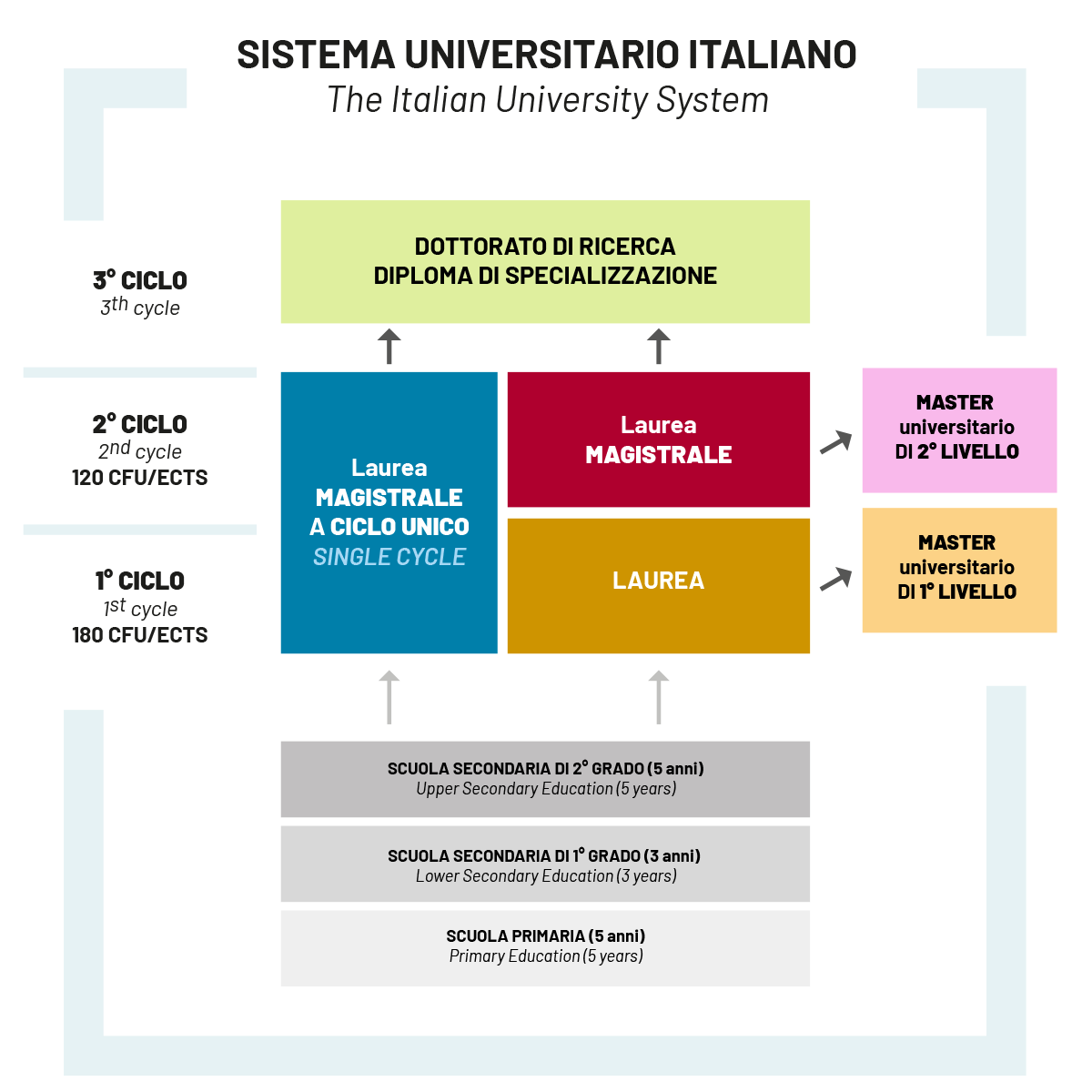
First-cycle degrees are aimed at enabling students to achieve a command of general scientific methods and content, and to acquire specific professional knowledge.Admission requirements: secondary school diploma after completing 13 years of study in total and passing the relevant State examination, or equivalent foreign qualification; admission may be subject to further assessment.
Duration: three years.
Graduation: in order to obtain the degree, it is necessary to gain at least 180 CFU; doing an internship and preparing a dissertation/thesis may also be required. Upon completion of a Bachelor’s degree, graduates may continue their studies by enrolling in a Master’s degree or other second-cycle degree programmes and courses.
Academic title: upon completion of a Bachelor’s degree (Laurea), graduates are awarded the title of “Dottore”.
Second-cycle degrees: Master’s degree
Second-cycle degrees aim to provide students with an advanced training and knowledge to take on highly-skilled roles.Admission requirements: applicants must hold a Bachelor’s degree, or a foreign equivalent qualification; curricular admission requirements for each course may vary depending on each University.
Duration: two years.
Graduation: in order to obtain the degree, it is necessary to gain at least 120 CFU, as well as preparing and presenting a dissertation/thesis.
Academic title: upon completion of a Master’s degree (Laurea Magistrale), graduates are awarded the title of “Dottore magistrale”. Single cycle/Combined Bachelor+Master’s degrees
Some courses (Medicine and Surgery, Veterinary Medicine, Dentistry and Dental Prosthetics, Pharmacy and Industrial Pharmacy, Architecture and Building Engineering-Architecture, Law, Primary Education) are offered as Single cycle/Combined Bachelor+Master’s degrees (Corsi di Laurea Magistrale a Ciclo Unico).
Admission requirements: applicants must hold a secondary school diploma or equivalent foreign qualification; admission is subject to passing an admission test.
Duration: five years (six years and 360 CFU for Medicine and Surgery, and Dentistry and Dental Prosthetics).
Graduation: in order to obtain the degree, it is necessary to gain at least 300 CFU, as well as preparing and presenting a dissertation/thesis. Upon completion of a Single-cycle degree, graduates may continue their studies by applying for a PhD programme (Dottorato di Ricerca) or other third-cycle courses.
Academic title: upon completion of a Master’s degree (Laurea Magistrale), graduates are awarded the title of “Dottore magistrale”.
Third-cycle degrees
PhD programmes: these courses enable students to gain reliable methodologies for advanced scientific research through innovative methodologies and new technologies, and generally include internships abroad and lab activities at research laboratories. Graduates wishing to apply for a PhD programme must have a Master’s degree (or a foreign equivalent qualification) and pass an open competition; PhD programmes have a minimum duration of three years. In order to complete the programme, students must produce a research thesis/dissertation and present it at a final examination.Academic title: upon completion of a PhD programme, students are awarded the title of “Dottore di ricerca”, or “PhD”.
Postgraduate specialisation courses: these are third-cycle courses aimed at enabling students to develop advanced knowledge and highly-specialised skills, such as in the medical, clinical and surgical fields. To be admitted to these courses, applicants must have a Master’s degree (or a foreign equivalent qualification) and pass an open competition. Postgraduate specialisation courses may last from two (120 CFU) to 6 years (360 CFU) depending on the type. Academic title: upon completion of this programme, graduates are awarded a “Diploma di Specializzazione”.
Professional Master’s programme
1st-level Professional Master’s programmes: these courses enable students to further enhance their scientific knowledge and professional skills. In order to apply, applicants must have a Bachelor’s degree, or foreign equivalent qualification. The minimum duration is one year (60 CFU). Please note that completing this course will not provide you with direct access to a PhD programme (Dottorato di Ricerca), or other third-cycle courses, as these courses are run and managed by each University at the local level. Upon completion of this programme, students are awarded a “Master universitario di primo livello”.2nd-level Professional Master’s programmes: these courses enable students to further enhance their scientific knowledge and professional skills. In order to apply, applicants must have a Master’s degree, or foreign equivalent qualification. The minimum duration is one year (60 CFU). Please note that completing this course will not provide you with direct access to a PhD programme (Dottorato di Ricerca), or other third-cycle courses, as these courses are run and managed by each University at the local level. Upon completion of this programme, students are awarded a “Master universitario di secondo livello”.
Other useful things
Crediti Formativi Universitari (CFU/ECTS credits): Italian university courses are based on the CFU system. 1 CFU is equal to 25 hours of study. The average annual academic workload for a full-time student is generally assumed to be 60 CFU. CFU and ECTS credits serve the same purpose and generally have the same value.Degree class: Bachelor's and Master's degree programmes that have the same learning objectives and activities are grouped into “degree classes". The educational content of each programme is set autonomously by each university; however, universities are required to include certain educational activities (and the corresponding number of CFU credits) set at the national level. These requirements are established in relation to each degree class. Degrees in the same class have the same legal value.
Double/Joint degrees: the Italian universities may establish degree programmes in partnership with other Italian or foreign universities. Upon completion of these courses, graduates are awarded a joint or double/multiple degree, one from each Partner University.
